The Development Divide: Balancing Speed, Affordability, and Great Design
Ben Simpson
February 17, 2026
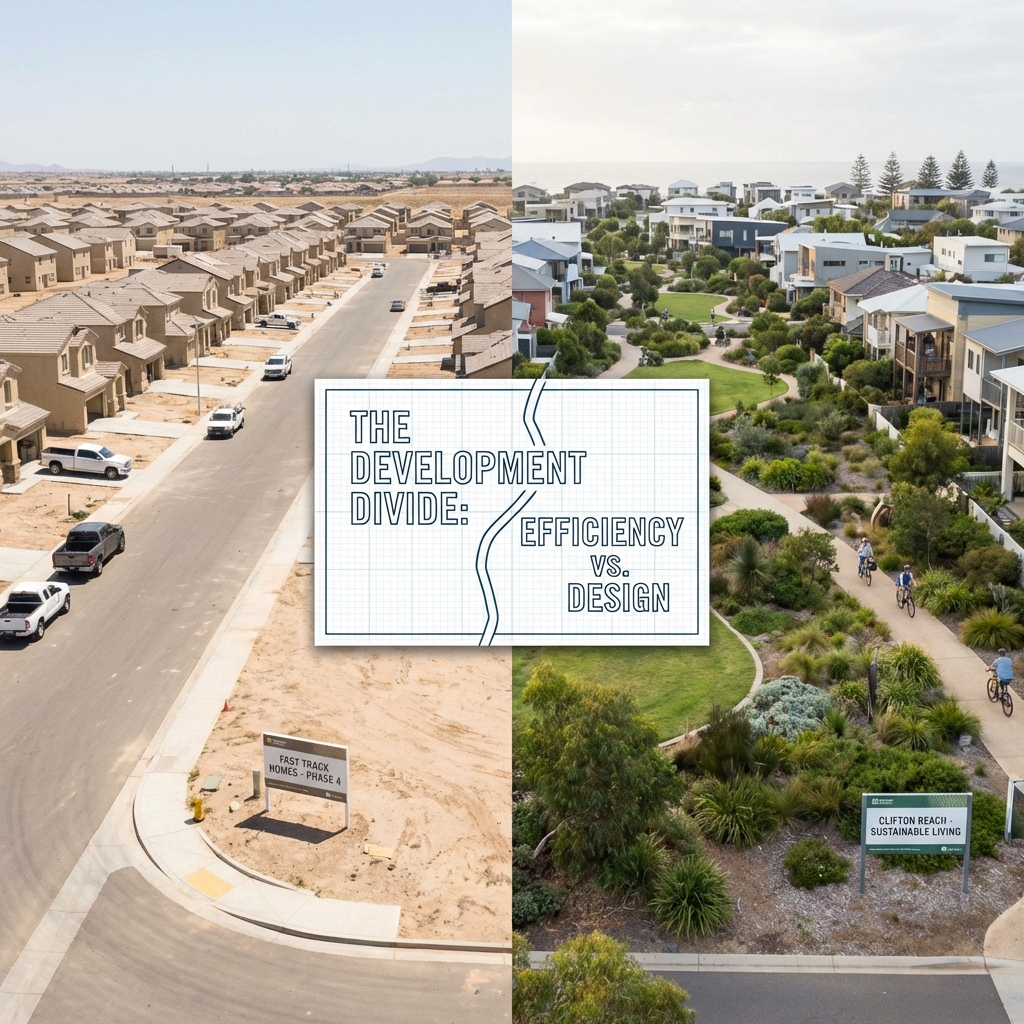
The image above captures one of the biggest challenges facing residential development today. On one side is efficiency: faster approvals, lower costs, and rapid housing delivery. On the other is design: walkability, community character, quality public spaces, and the creation of places people genuinely want to live.
Too often, these objectives are treated as competing priorities.
After nearly three decades delivering residential communities across Australia and the United States, I've come to believe the most successful communities don't choose between them. They find a way to deliver all three.
The Communities I Saw - And The Ones I Didn't
Three years before my family and I relocated to the United States, I spent several weeks travelling across the country studying some of the most celebrated master-planned communities America had produced.
As someone who had spent more than sixteen years delivering large-scale communities in Australia, I wanted to understand what made the best American projects so successful. My journey took me to places such as The Woodlands, Texas; Summerlin, Nevada; Seaside, Florida; Reston, Virginia; and Irvine, California. These communities were widely regarded as benchmarks for planning, placemaking, and long-term value creation.
I came away impressed.
The scale was extraordinary. The integration of housing, parks, schools, retail, recreation, and employment demonstrated what could be achieved when communities were planned with a long-term vision. These places weren't simply housing developments, they were complete communities.
What I didn't see were the other communities.
I didn't see the partially completed subdivisions sitting on the edge of growing cities. I didn't see the abandoned infrastructure, unfinished amenities, or half-built neighborhoods that had become casualties of the Global Financial Crisis.
It wasn't until I relocated to Atlanta in 2019 and began travelling extensively throughout the Southeast that I encountered these places firsthand. One of the first was a community in coastal North Carolina where alligators had taken up residence inside the stormwater pipe network. Grand entry monuments had become overgrown, sections of pavement were deteriorating, and only a handful of occupied homes remained scattered amongst hundreds of undeveloped lots.
These "zombie communities" told a story that the award-winning projects never could.
Importantly, they did not represent American development at its best. The United States continues to produce exceptional communities. Projects such as Lakewood Ranch, Florida; Bridgeland, Texas; Daybreak, Utah; and Nexton, South Carolina demonstrate that world-class placemaking remains alive and well.
What surprised me wasn't the existence of great communities. It was discovering how profoundly the downturn had reshaped the broader development ecosystem behind them. Entire development companies disappeared. Experienced professionals left the industry. Institutional knowledge was lost. Capital became more cautious. Risk appetites changed.
The award-winning projects showed what America could achieve.
The unfinished projects revealed the scars left behind.
Understanding both became one of the most valuable lessons of my career.
Two Markets, Two Different Priorities
The Global Financial Crisis left lasting scars on both Australia and the United States, but the impacts were very different.
In America, the downturn wiped out large parts of the residential development industry. Entire career paths disappeared, creating a talent vacuum that still exists in many markets today. In numerous regions, national builders stepped in to perform functions previously undertaken by specialist land developers, while smaller fee developers emerged to fill gaps in the market.
Australia experienced a different outcome. Stronger banking regulation and tighter lending standards insulated much of the residential development sector from the worst effects of the crisis. While the industry certainly felt the impacts, much of its institutional knowledge, development capability, and long-term planning expertise remained intact.
The result was a fascinating natural experiment: two advanced economies, two strong housing markets, and two development industries that evolved in different directions.
What America Does Well
One thing immediately stood out when I began working in the United States.
Things move.
Particularly throughout the Sunbelt, many jurisdictions understand the importance of housing supply and work pragmatically with the private sector to keep projects advancing. Compared with many international markets, the ability to move projects from concept to approval can be remarkably efficient.
That responsiveness creates significant advantages. Communities can react more quickly to changing market conditions, housing can be delivered faster, and developers have greater flexibility to adapt products as demand evolves.
This speed has helped support extraordinary population growth throughout markets such as Texas, Florida, Georgia, Tennessee, and the Carolinas.
But speed alone does not guarantee great places.
Some communities achieve both. Others prioritise housing delivery at the expense of long-term character, connectivity, or identity.
Like any system, its strengths can also become weaknesses.
What Australia Does Well
Australia has traditionally placed a greater emphasis on placemaking, community design, and long-term outcomes.
Developers are generally expected to think beyond lot yields and consider how parks, schools, community facilities, open space networks, streetscapes, and housing diversity work together to create a cohesive neighborhood.
Many of Australia's most successful master-planned communities are recognised not simply for the number of homes they delivered, but for the quality of life they created.
However, that doesn't mean Australia consistently gets it right either.
Over time, approval processes have become increasingly complex, costly, and time-consuming. Projects that once took years to approve can now take significantly longer, adding cost and uncertainty at precisely the time housing affordability is under pressure.
The systems designed to protect community outcomes can sometimes make housing more difficult to deliver.
Like America, Australia's strengths can also become weaknesses.
Neither System Is Perfect
One of the most important lessons I've learned working across both countries is that neither system has all the answers.
America can move quickly, but speed alone does not guarantee enduring communities.
Australia often delivers strong placemaking outcomes, but lengthy approval processes can undermine affordability and housing supply.
Both countries produce exceptional communities. Both also produce projects that fall short of their potential.
The challenge isn't deciding which system is better.
The challenge is understanding what each system does well and finding ways to combine those strengths.
The Housing Challenge We All Share
Despite their differences, both countries now face a remarkably similar problem.
There simply aren't enough homes.
The United States faces a housing shortage estimated in the millions of homes. Australia is projected to fall hundreds of thousands of dwellings short of national housing targets over the coming years. Both countries are grappling with rising construction costs, workforce shortages, infrastructure constraints, and declining affordability.
At the same time, communities are being asked to deliver more than ever before. They must provide housing, support economic growth, create social connection, encourage healthier lifestyles, and remain resilient in the face of changing demographics and market conditions.
This is where the traditional trade-off between efficiency and design begins to break down.
Because increasingly, we need both.
The False Choice Between Efficiency and Design
One of the biggest misconceptions in our industry is that efficiency and design sit at opposite ends of a spectrum.
The reality is that the best communities demonstrate the opposite.
Thoughtful design often reduces long-term risk. Walkable neighborhoods create stronger demand. Quality public spaces enhance community pride and resilience. Diverse housing options broaden market appeal and improve adaptability over time.
Communities that successfully integrate these elements tend to perform better through market cycles because they attract a wider range of residents and remain relevant for longer.
Good design is not the enemy of efficiency.
Done properly, it enhances it.
The challenge is not choosing between the two, but finding smarter ways to deliver both.
The Opportunity Ahead
The future of residential development is unlikely to look entirely American or entirely Australian.
The communities that will thrive over the coming decades will combine the best characteristics of both approaches: the responsiveness, pragmatism, and housing delivery focus often found in America's fastest-growing markets, together with the placemaking, design quality, and long-term stewardship that underpin many of Australia's most successful communities.
Neither country has perfected the formula.
But both have valuable lessons to offer.
Building Communities That Endure
The most successful communities are rarely defined by how quickly they were approved or how many lots they delivered.
They're remembered because they endure.
They adapt to changing market conditions. They create lasting value for residents. They support local businesses, schools, parks, and community life. They become places people are proud to call home.
Those outcomes don't happen by accident. They are the result of deliberate decisions made during acquisition, planning, design, entitlement, infrastructure delivery, and long-term stewardship.
After nearly three decades working across two very different housing markets, I've become convinced that the future lies not in choosing between efficiency and design, speed and quality, or housing supply and placemaking.
The real opportunity is learning how to deliver all of them together.
Because the communities that thrive in the future won't be the ones that optimized for a single outcome.
They'll be the ones that balanced speed, affordability, and great design - and proved those goals never needed to be in conflict in the first place.
Related posts
More ideas, stories and innovations from the team at Placewell.
Get in touch
See how we can bring your vision to life.
Our team works with you from day one, shaping a commercially viable vision, verifying key assumptions, and assembling the right experts to turn your ideas into thriving communities.
About us
Meet the experts behind your communities.
Our team combines award-winning expertise, hands-on experience, and a people-first approach to deliver communities that thrive. Get to know the professionals shaping every project from vision to reality.